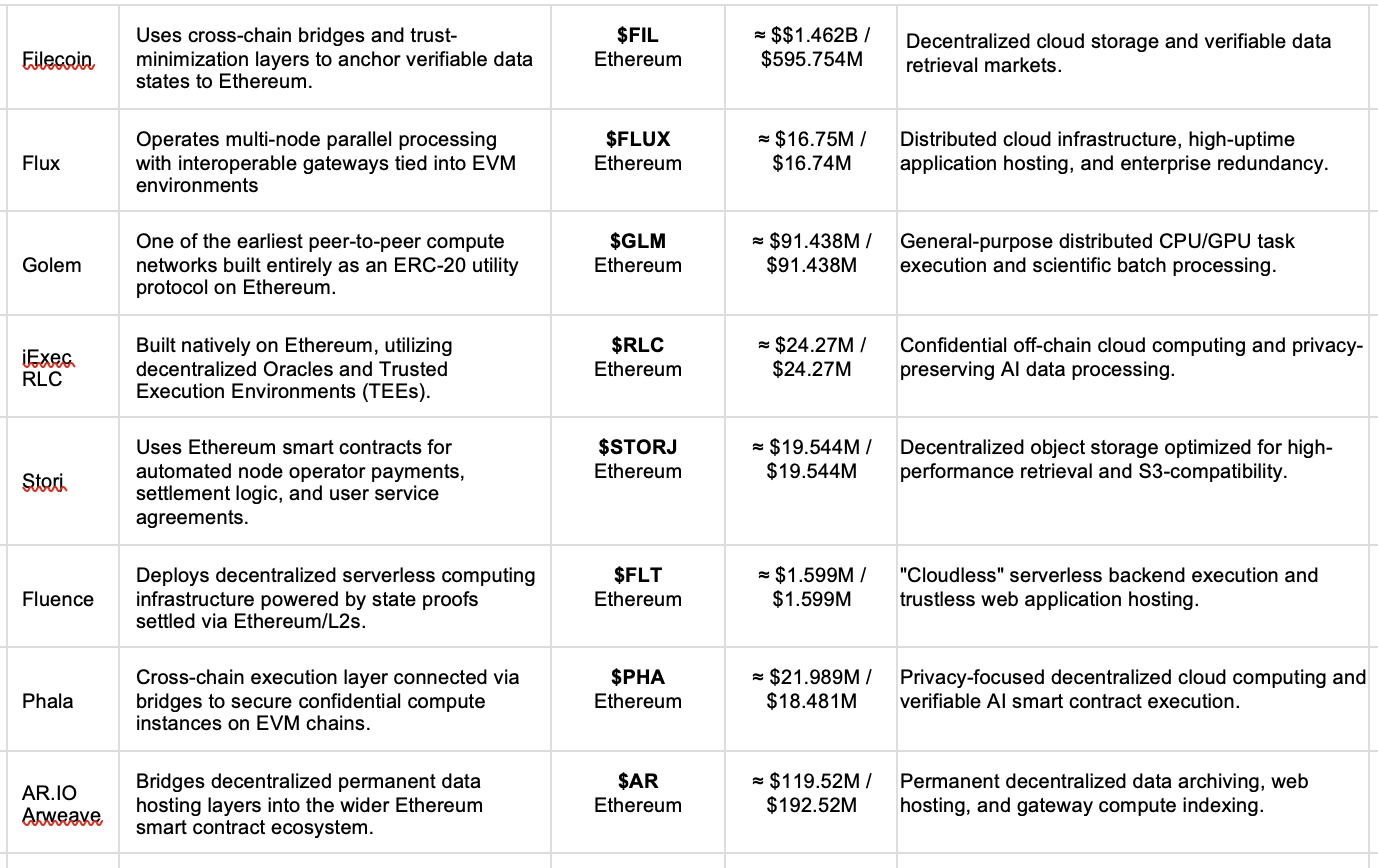
Ghost DAO has been searching for a clean way to inject real liquidity into mainnet without turning into yet another mercenary yield farm. The answer might be hiding in plain sight: DePIN high‑compute providers.
DePIN GPU networks like Aethir, Akash, Render, io.net, and Gensyn are already breaking away from the old hyperscaler model of dollar‑denominated debt. They finance growth with token‑backed reserves, provider incentives, and onchain revenue, not levered bank loans. The catch is that their tokenomics and incentive structures are still doing most of the heavy lifting: rewards must attract providers, fees must sustain the network, and token emissions can become a drag if not paired with a robust external yield layer. DePin Compute tokens have not performed setting up the possibility for a quinella: liquidity + community + on chain revenue + Prinicple 3 acquisitions.
Ghost’s edge is simple:
Plug DePIN compute into a permissionless, anonymous, yield‑bearing treasury so providers and their customers can earn superior onchain APY on idle balances, and align long‑term incentives around real revenue, not just emissions.
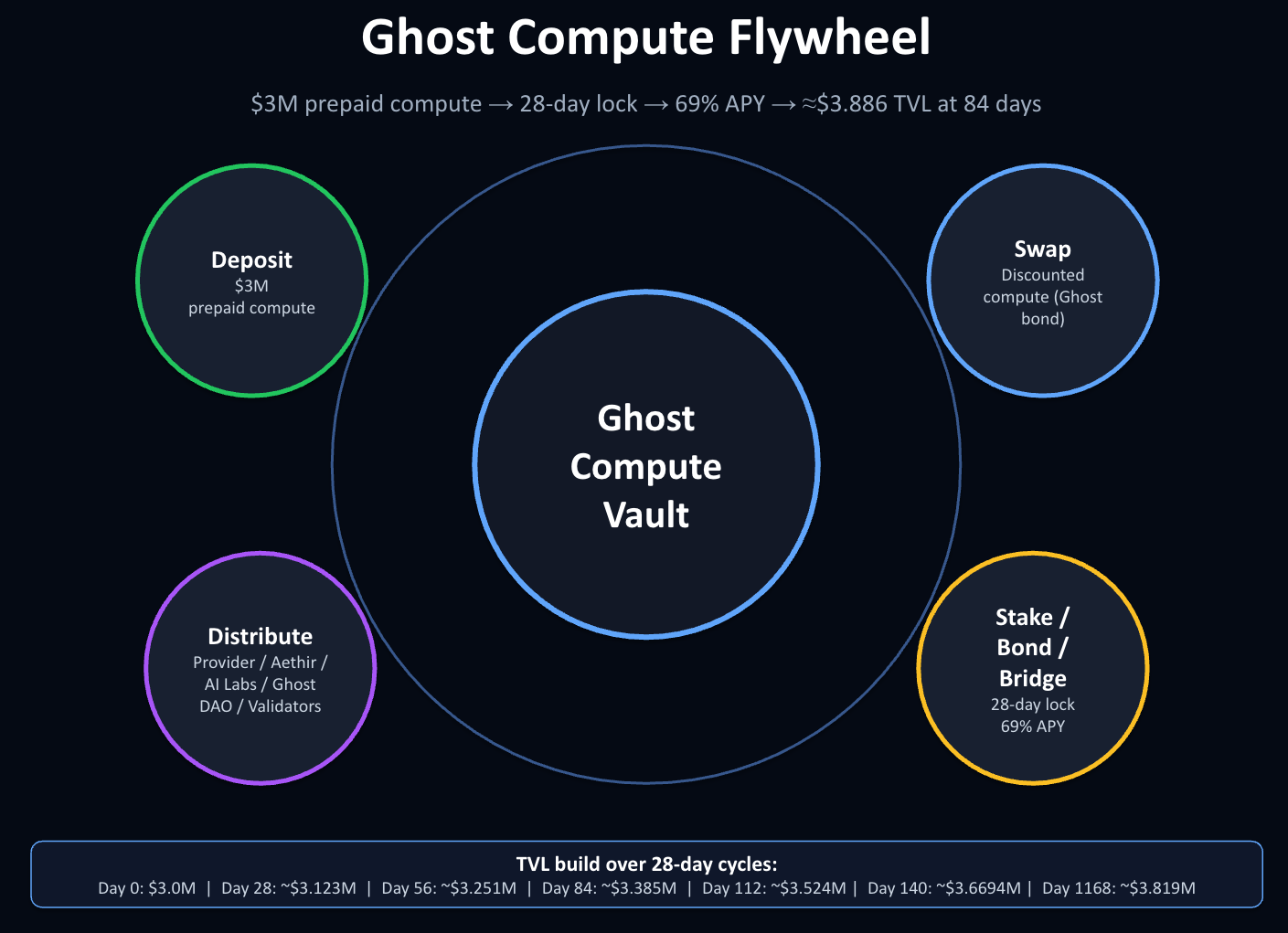
What might the Ghost DePIN Compute Flywheel look like?
Background
The Problem: Dollar Debt vs. Falling Compute Prices
AI and cloud companies are financing massive capex with dollar debt. Hyperscalers alone are on track for roughly $600B of capex in 2026, with about 75% directed to AI infrastructure. That creates a dangerous mismatch: liabilities are fixed in dollars, while the value of compute assets tends to fall over time as hardware improves and prices drop similar to how inflation erodes the purchasing power of cash.
When compute prices decline, dollar‑denominated borrowers face rising real burdens. The asset they bought (compute capacity) is worth less in both performance and price terms, but the debt remains unchanged. This is the same structural risk that has long made commodity producers and capital‑intensive industries wary of pure dollar financing.
The Compute‑Backed Alternative
Bob Gelfond and Byron Gilliam argue for a different structure: obligations denominated in units of compute (e.g., “one hour on a benchmark GPU”) that can circulate as money and be redeemed into actual capacity. For AI labs, such claims are not just financial instruments; they are direct hedges against their largest operating cost. Holding compute‑denominated balances preserves purchasing power in terms of compute, unlike holding dollars or even dollar stablecoins.
This is the “ancient future of finance”: using a real, productive asset as money so that balance sheets are aligned with the underlying economics of the business.
Gelfond mentions in passing that this new form of money “could be held anonymously on a blockchain,” with full disclosure of outstanding issuance and staking yield to maintain purchasing power. Where Ghost departs from Gelfond is his assumption that these chains will be permissioned, KYC’d, and centralized.
In practice, there are two worlds of compute financing. Hyperscalers and centralized cloud providers that are still trapped in the dollar‑debt model: banks and private credit funds lend in USD, firms buy GPUs, and then watch those assets depreciate while their liabilities stay fixed. That’s the mismatch Gilliam and Gelfond are warning about.
DePIN GPU networks like Aethir are taking a different path: they finance expansion with token‑backed reserves and cashflows (e.g., ATH‑funded Digital Asset Treasuries and Strategic Compute Reserves) instead of levered dollar loans. Both worlds point to the same “ancient future of finance” thesis; compute should be financed and hedged in compute terms, but DePIN providers are already halfway there. Ghost DAO’s opportunity is to become the permissionless, anonymous, yield‑bearing layer that connects these token‑backed compute reserves to broader liquidity, so compute can be financed without dollar debt while still tapping deep capital pools and permissionless DAO communities.
Where Ghost DAO Can Fit
Ghost DAO already operates a yield‑bearing, governance‑oriented token stack (eGHST/sGHST/GHST) backed by treasury assets, with staking, bonding, and protocol fees flowing to the DAO. Ghost Auction could add a near‑term revenue and protocol‑owned liquidity (POL) engine, projected to generate $3.8M–$8.8M in Year 1 from fees and B2B integrations if execution lands.
In the Compute Finance layer, Ghost’s role can sit between DePin compute providers and compute buyers as an onchain treasury and settlement layer, not as a compute broker:
· DePin Compute providers (decentralized GPU networks like Aethir, Akash, Render, io.net, Gensyn) issue prepaid service credits in their own compute standard, backed by locked staked capacity and surplus token economics.
· Existing customers and friendly AI labs buy these credits directly from the providers; credits are pre‑sold, not warehoused by Ghost.
· Ghost runs vaults that accept stablecoins and provider/network tokens (e.g., ATH, AKT, RNDR) from providers and their top customers, deploys this capital into Ghost Auction fees, staking, bonding, bridging, and POL strategies, and routes real onchain yield back to depositors and the Ghost treasury.
Ghost does not need to become a compute chain. It can use high‑throughput L1s (including CSPR, Ethereum, and BTC/UTXO bridges) as execution rails while structuring yield‑bearing products whose cash flows are tied to actual onchain revenue and compute utilization, not synthetic emissions
Why Decentralized Compute Providers and Buyers Will Choose Ghost
For decentralized GPU networks and their customers, Ghost offers three clear advantages over pure dollar or stablecoin treasuries:
1. Yield on idle balances
Providers and buyers hold idle stablecoins and network tokens between payouts, purchases, and reinvestment. Ghost’s vaults allow them to park these balances and earn real onchain APY from auction fees, staking, bonding, bridging, and POL, instead of leaving them at zero yield.
2. Compute‑aligned risk and incentives
By pairing prepaid compute credits with onchain yield products, Ghost helps match incentives: providers post collateral and locked capacity; customers pre‑pay for compute; Ghost routes fees and yield. The risk is aligned with actual compute economics, rather than purely with token speculation.
3. Permissionless, non‑KYC access
Many DePIN GPU providers and AI labs prefer crypto‑native rails and minimal friction. Ghost’s permissionless, privacy‑oriented DAO design is culturally closer to Aethir or Akash than to large L1 foundations that have moved away from actively supporting permissionless experiments.
Market Size and Wedge
The addressable market spans centralized and decentralized compute providers:
· Hyperscaler AI capex (2026): ~$450B in AI infrastructure spend.
· Data center GPU market (2026): ~$48.4B, growing strongly.
· Decentralized GPU compute networks: Early‑2026 on‑chain revenue is estimated at $180–220M annually across protocols like Aethir, Render, Akash, io.net, and Gensyn, with decentralized AI compute at ~$12.2B in 2024 and projected to reach ~$39.5B by 2033. This is Ghost’s wedge and ICP.
· DePIN overall: DePIN market caps and onchain revenue are now material, with GPU and storage networks emerging as real infrastructure businesses.
Even a small slice of this ecosystem; one provider pilot with $3–$5M in prepaid credits and vault deposits is enough to bootstrap POL for Ghost mainnet and prove a new, compute‑backed yield asset class.
How Ghost Executes (Pilot First, Then Expansion)
1. TBD: Launch Ghost Auction first to generate baseline POL and fees, routing a defined share into an Acquisition Reserve and into the Compute Treasury Vault.
2. Run a single‑provider pilot (e.g., Aethir):
o Provider issues $1–$5M of prepaid compute credits in its own standard.
o Existing customers and friendly AI labs buy these credits.
o Ghost vaults accept stablecoins and ATH (plus optional POL/ARB/AVAX), deploy capital into onchain yield strategies, and route APY to providers and the Ghost treasury.
o Verification and fraud penalties are built in: misreporting or failure to deliver reduces rewards and future participation.
3. If successful, add additional providers (Akash, io.net, Gensyn, etc.), each with a single compute standard and its own vault configuration.
4. Use Principle 3 to selectively acquire or deepen exposure to token‑native compute/GPU/AI infra projects that plug into this stack, turning Ghost into a long‑term compute‑backed finance layer
Ghost DAO’s pitch to the Decentralized Compute Providers is simple: instead of financing AI capex with pure dollar debt and holding idle dollars or generic L1 tokens, use a compute‑linked, yield‑bearing layer that injects meaningful liquidity into Ghost mainnet and aligns treasury incentives with real onchain revenue producers—decentralized GPU networks that still want permissionless, DAO‑native partners.
A Draft Pilot Proposal for Aethir:
Objective
Design a focused pilot where Ghost DAO’s permissionless, yield‑bearing treasury and settlement layer wraps Aethir’s prepaid compute credits, creating a new, compute‑backed yield product for Aethir’s existing customers and providers.
This is not a trillion‑dollar compute pitch. It is a single‑provider, single‑standard pilot: one network (Aethir), one compute unit, $1–$5M of prepaid service credits, and a clear path to real POL and fee revenue.
If successful, the Vault of prepaid compute credits can expand from $1-$5M pilot to $10-$20M, or Ghost DAO can consider bringing in another decentralized compute provider highlighted in the Compute Provider Ranking Document.
Pilot Scope and Roles
• Provider: Aethir defines the compute unit (e.g., “X units of Aethir GPU capacity”) and issues prepaid service credits backed by locked, staked compute and disclosed capacity.
• Buyers: Aethir’s existing customers and friendly AI labs/network buyers purchase these credits directly from Aethir.
• Ghost: Ghost DAO provides the treasury vault, yield routing, and settlement layer; it does not buy or warehouse compute claims itself.
Ghost DAO’s role: Permissionless, yield‑bearing treasury and on chain revenue settlement layer.
Aethir’s role: Leading decentralized GPU network with real revenue, providers, and buyers.
Together: A practical, compute‑backed finance wedge that can scale from a focused pilot into a broader standard for AI infrastructure.
Why Aethir × Ghost
- Yield on idle compute‑linked balances
Aethir and its top providers hold idle stablecoins and ATH between payouts and reinvestment. Ghost’s vaults can pay real on chain APY (from staking, bonding, bridging and POL strategies) on these balances, with providers rewarded for posting collateral. - Compute‑aligned treasury
Aethir’s Strategic Compute Reserve and digital asset treasury already frame GPU capacity and ATH as financeable assets. Ghost extends this by attaching transparent yield products to prepaid credits without touching Aethir’s core protocol. - Permissionless, non‑KYC rails
Many GPU providers and AI labs prefer crypto-native, light‑KYC flows. Ghost’s privacy‑oriented, DAO‑governed architecture matches that culture and makes cross‑border settlement easier. - Controlled demand expansion
Ghost does not introduce speculative agents in the pilot. It routes prepaid credits and yield to Aethir’s existing buyers, making the experiment operationally tractable.
Pilot Design (V1)
Phase 1: Aethir Compute Treasury Vault
• Ghost sets up a vault that accepts:
o Stablecoins (USDC/DAI) posted by Aethir’s treasury and selected providers.
o ATH or other Aethir‑approved collateral.
• Capital in the vault is deployed into:
o Short‑duration, transparent onchain yield strategies (staking, bonding, bridging, POL)
• Yield is distributed to vault depositors; a defined share flows to the Ghost treasury and Aethir under a simple revenue share.
Phase 2: Prepaid Compute Credit Pilot
• Aethir issues $1–$5M of prepaid service credits in its own compute standard (not a generic token), backed by locked staked capacity and surplus token economics.
• These credits are sold to Aethir’s existing customers and friendly AI labs.
• Ghost handles settlement and yield accounting around those credits; the delivery obligation remains with Aethir.
Phase 3: Provider Program
• Aethir invites its top 20–50 providers to opt into the vault.
• Providers can park a portion of their idle stablecoin/ATH balances in Ghost products and earn yield while their staked capacity backs the prepaid credits.
• Aethir and Ghost co‑market this as “yield on idle GPU revenue” with clear docs and dashboards.
Execution Risk Controls
-
Single standard, single provider
The pilot uses Aethir only and one compute metric, avoiding multi‑network standardization risk which would be a future requirement but not now. -
Verification and fraud penalties
o Aethir must publish onchain metrics for staked capacity, issued credits, and utilization.
o Misreporting or failure to deliver triggers explicit penalties (e.g., slashed rewards, credit clawbacks, or reduced future vault access). -
Real APY, no synthetic compute yield
o APY is paid from real onchain revenue (staking, bonding, bridging, POL), not directly from the compute unit.
o The reward is an incentive for collateral and participation, not a promise tied to speculative token emissions. -
Limited balance‑sheet exposure for Ghost
o Ghost does not hold unsold compute inventory; credits are pre‑sold to Aethir’s customers, and Ghost’s exposure is limited to vault flow and treasury strategies.
o Initial pilot size ($1–$5M) is small and easily monitored. -
No agents in pilot
o Agentic buyers are excluded from V1.
o Only human‑run labs and existing customers participate, simplifying UX, key management, and behavior risk.
Why This Is A Real Risk Adjusted Opportunity to BootStrap Main Net TVL
• Aethir already reports ~$128M+ in annual revenue and >$166M ARR with a large, active provider base and a Strategic Compute Reserve.
• A $1–$5M prepaid credit pilot is a contractible slice of their existing business, not a new speculative product.
• If it works, the vault template can be reused for additional providers and networks; if not, it can be wound down with limited impact.
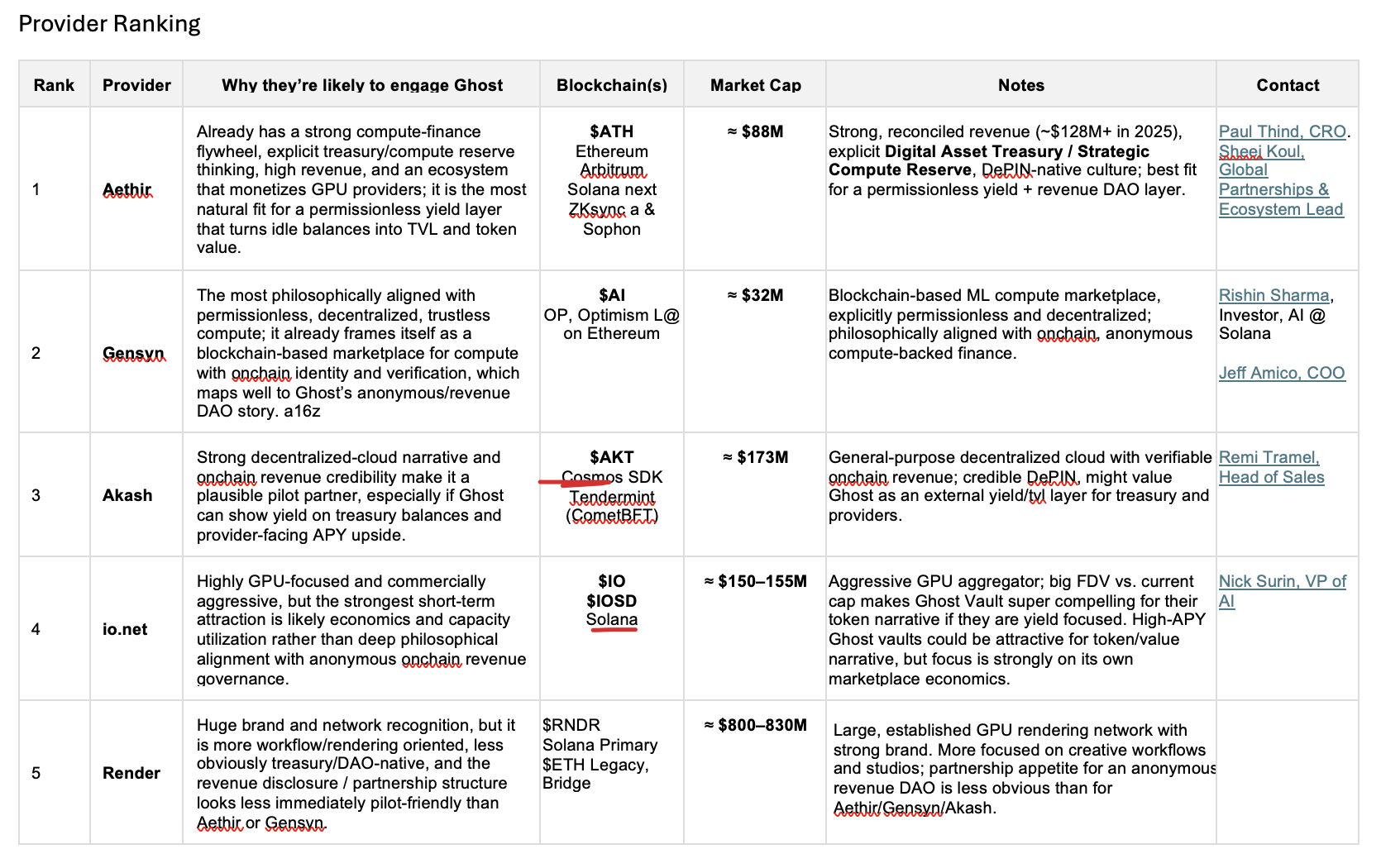
DePin Compute Provider Ranking (Candidates for Pilot One)
DePin Compute Additional Considerations (Ethereum Only)